Galerie Hubert Winter
Kandis Williams, SOLDIER PSYCHO: (...) (2024)
Paper, collage, color aid and adhesive on wood, 66 x 47 in
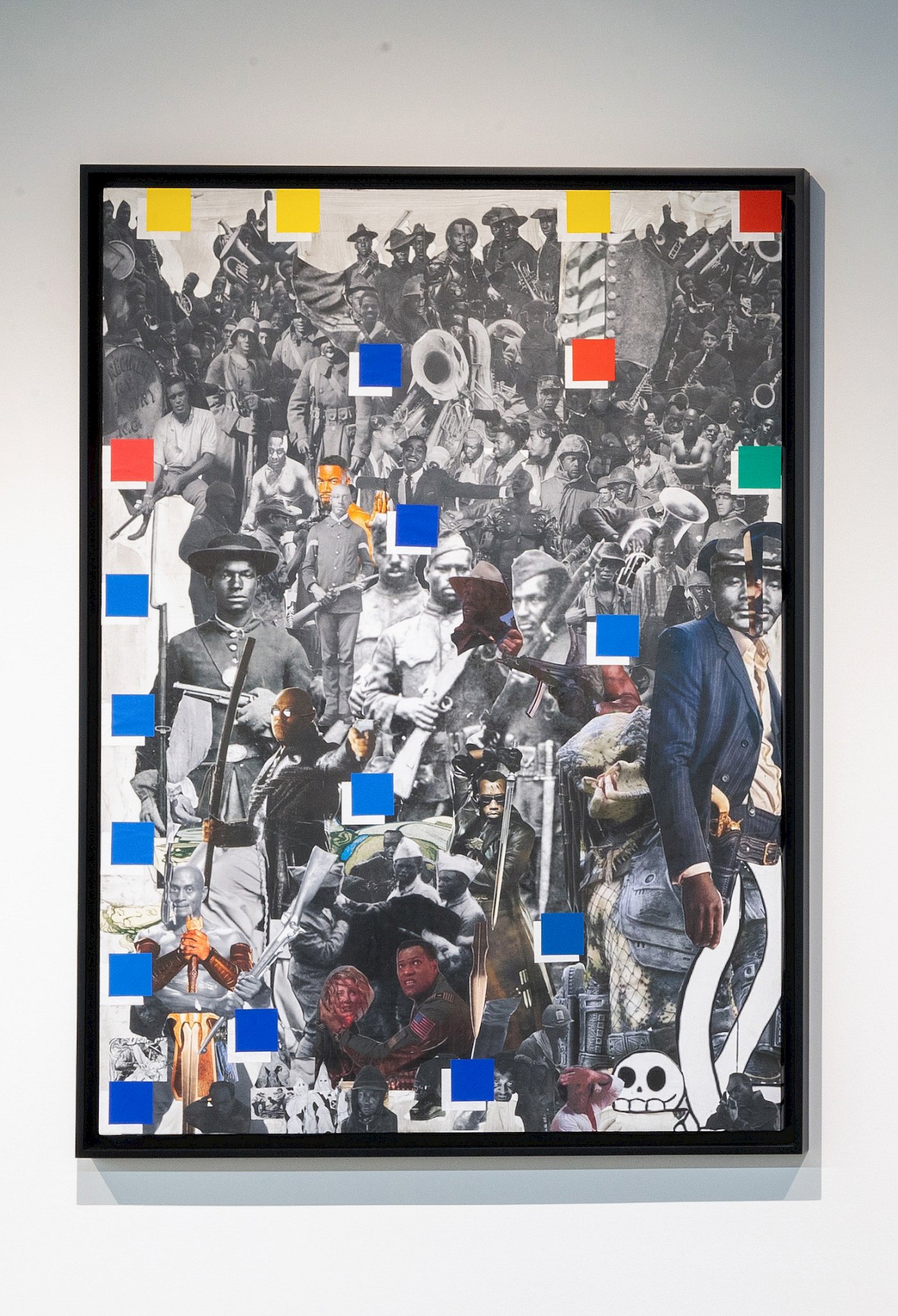
<p class="caption"><strong>Abbreviation of title:</strong></p>
<p>SOLDIER PSYCHO: “This is your last chance. After this, there is no turning back. You take the blue pill—the story ends, you wake up in your bed and believe whatever you want to believe. You take the red pill—you stay in Wonderland, and I show you how deep the rabbit hole goes”</p>
<p class="caption"><strong>Full title:</strong></p>
<p>SOLDIER PSYCHO: “This is your last chance. After this, there is no turning back. You take the blue pill—the story ends, you wake up in your bed and believe whatever you want to believe. You take the red pill—you stay in Wonderland, and I show you how deep the rabbit hole goes” (Morpheus, 1999). “The aesthetics of settler imperial failure contained in the transpacific cultural works I analyze allows us to think through the relationship between settler colonialism and military empire in this way: settler colonialism is at once military empire’s proving ground, obscured condition of possibility, and imbricated partner in violence. The United States as the literal testing ground for biopolitical tactics and technologies that are geopolitically and militarily projected abroad has produced and continues to produce Native American displacement and dispossession, and that geopolitical and military projection abroad in Asia and the Pacific in turn produces Asian migration and Indigenous Pacific Islander displacement and dispossession” (Kim, 2018, p. 16). “Ghosts are cosmological strangers in social classification, as noted previously, but their phenomenal (or ‘social’) existence, by definition, is inseparable from a particular history of death. The category of ghosts is a product of the interplay between cultural concepts and historical reality: the spirits of the dead fall into this category through a crisis in the social organization of commemoration and the historical events that cause this crisis” (Gordon). “That is, interracial intimacies move the politics of the public sphere to the erotics of the private sphere through the tropes of race, gender, and heterosexuality that come to displace the broader politics at work within these particular bodies…describes as ‘masculinities in the contact zone’” (Rowe).</p>