Helga Philipp was of central importance in the Viennese art scene of the sixties – she founded a new constructive-geometric current along with colleagues such as Marc Adrian, Kurt Ingerl or Hildegard Joos. Its roots are in the abstract ornaments of the post – 1900 Wiener Werkstätte and in the Viennese Kinetics of Franz Čižek in the twenties. The students of Fritz Wortuba, Karl Prantl, Josef Pillhofer and Fritz Hartlauer, were also close this movement as abstract sculptors. The Abstraction-Création group, the concrete movement with Max Bill and Kinetic Art were all important international influences.
......
Philipp´s “Kinetic Object” (1962/63) is a prime example of Op Art; its 3D effects with seemingly curved circles and other appealing visual illusions from varying points of view. László Mohology-Nagy wrote about the kinetic phenomenon of virtual volume in his 1929 book, von material zu architektur (from material to architecture) after Naum Gabo surmounted, two-dimensional motion on the surface in futuristic painting in 1920. Jean Tinguely, Gianni Colombo or Stanislav Filko continued with this in the fifties and sixties, and in 1967 Jésus Rafael Soto spoke of “virtual relations”. Kinetics doesn´t only mean real movement, it also means illusory movement. In Op Art the movement reaches beyond the object to grip the beholder. With his movement, the beholder creates optical illusions and virtual effects.
.....
image
viewer
existence of the image
existence of the viewer
mutual relationship
viewer – image
image – viewer
existence of the image through the viewer
existence of the viewer through the image
movement of the viewer towards the image
movement of the image with the viewer
counter – movement
image – viewer
viewer – image
incorporation of space in the image
movement in space and movement of the viewer through the image
movement of the image through the viewer and space
change of the image through change of light
change of the image through change of the viewer
quality of the viewer
quality of the image
Nobody in Vienna recognized this as clearly as Helga Philipp. Her mid-sixties manifest defines the painting-beholder relation right up to the present and is relevant for media art today. She did not change into this field herself, as did Adrian and Otto Beckmann, but she did set down key terms for the decade in terms of beholder – image – movement – space – light change. The artist also linked transformation and variability as the aim of a work of art with the metrical film of Peter Kubelka, and in 1965 Kurt Kren made the expanded field of optical effect visible using a painting of Philipp.
Her participation in important exhibitions such as Nova Tendencija (1965 and 1969 in Zagreb), Werner Hofmann´s “Kinetika” in 1967 and on repeated occasions in the Galerie nächst St. Stephan made her one of the most important post-1945 Neo-Avant-garde artists.
She chose the most innovative materials by using mirrors (joint projects with Arnulf Komposch), plexiglass, aluminium, rubber and silk screen, and she can be considered one of the founders of Austrian art in public spaces with he Stadtpark activities. The works didn´t only hang from the wall, they also hung from the roof or they lay on the floor. She used neon lighting tubes, and transferred the geometric vocabulary to furniture.
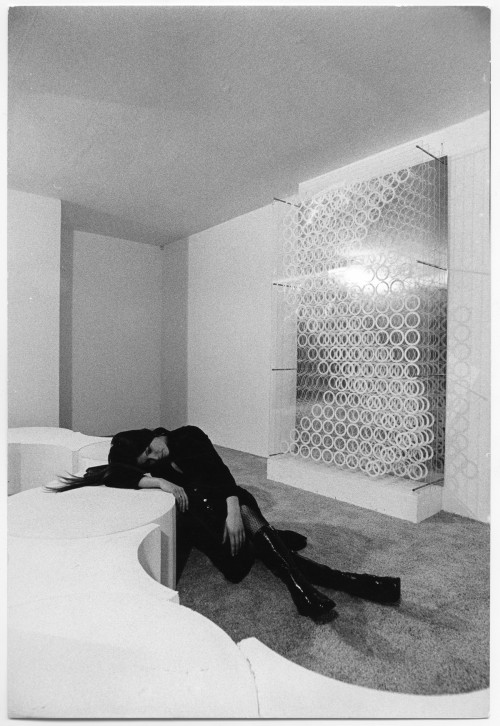
The combinatorics of basic geometric shapes and the interference of these on transparent image layers are an indication of her advance from the space for perception to the space for thought. By doing so, she anticipate Minimal Art and Concept Art. This is what makes her work so historically significant.